
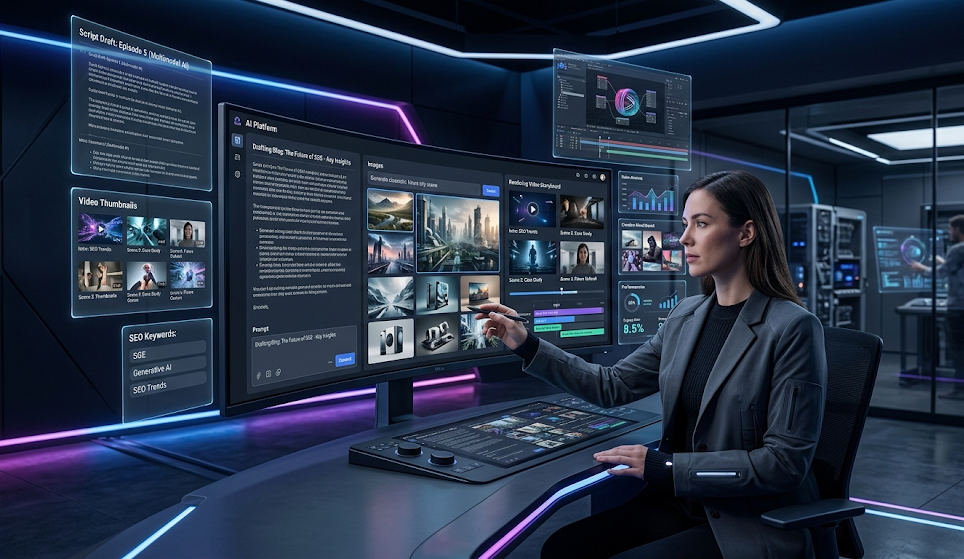
The digital content landscape is undergoing one of the most significant transformations in history, driven by the rise of multimodal artificial intelligence. Unlike traditional AI systems that focus only on text generation, multimodal AI can process and generate multiple types of content including text, images, audio, and video. This shift is redefining how creators, marketers, journalists, and businesses produce and distribute digital content.
Multimodal AI content creation refers to the use of advanced AI systems that can understand and generate content across different formats simultaneously. Instead of working separately with writing tools, design tools, and video editing software, creators can now rely on unified AI systems that integrate all these capabilities into a single workflow.
This evolution is not just about convenience; it represents a fundamental change in how stories are created and experienced online. In an era where audiences demand engaging, interactive, and visually rich content, multimodal AI is becoming a central pillar of modern digital communication.
Understanding Multimodal AI Content Creation
Multimodal AI is built on advanced machine learning architectures capable of processing multiple types of input and output. Traditional AI models are typically trained on one type of data, such as text or images. In contrast, multimodal systems combine datasets from different formats, allowing them to understand relationships between text, visuals, and motion.
For example, a multimodal AI system can take a written prompt like “create a marketing video for a fitness brand” and generate a script, design visual scenes, produce images or animations, and even synthesize voiceovers. This integration allows for a complete content production pipeline powered by a single AI system.
At its core, multimodal AI works by mapping different types of data into a shared representation space. This means text, images, and videos are understood in relation to each other, enabling seamless cross-format generation.
The Evolution of Content Creation
Content creation has evolved through several stages over the past few decades. Initially, content was purely text-based, focused on blogs, articles, and written communication. With the rise of social media and broadband internet, visual content became dominant, leading to the growth of image-based platforms and video streaming services.
The next phase introduced digital tools for design and video editing, allowing creators to combine multiple formats manually. However, this process still required specialized skills and significant time investment.
Now, with multimodal AI, the entire process is becoming automated and unified. Creators no longer need separate tools for writing scripts, designing visuals, or editing videos. Instead, AI systems can generate all these elements together in a cohesive format.
This evolution represents a shift from manual content assembly to intelligent content generation.
How Multimodal AI Works
Multimodal AI systems rely on deep learning models that are trained on large datasets containing text, images, audio, and video. These models use transformer architectures and neural networks to understand patterns across different data types.
When a user inputs a prompt, the AI processes it through multiple layers. First, it interprets the textual meaning. Then it connects that meaning to visual and auditory concepts. Finally, it generates outputs in the required formats.
For instance, if a user requests a product advertisement, the AI may first generate a script, then create visual scenes, design graphics, and finally produce a video with voice narration and background music.
Some advanced systems also allow iterative refinement, where users can adjust individual elements such as tone, color scheme, pacing, or narrative structure.
Benefits of Multimodal AI Content Creation
One of the most significant advantages of multimodal AI is efficiency. It drastically reduces the time required to produce complex content. What previously took teams of writers, designers, and video editors can now be accomplished in a fraction of the time.
Another key benefit is cost reduction. Businesses no longer need to invest heavily in multiple specialized tools or large creative teams for every project.
Multimodal AI also enhances creativity. By combining different forms of content generation, it allows creators to experiment with new storytelling formats that were previously difficult or expensive to produce.
Scalability is another important advantage. Organizations can generate large volumes of content across multiple platforms and formats without compromising consistency.
Additionally, multimodal AI improves accessibility. Even individuals without technical or design skills can create professional-quality videos, images, and written content using simple prompts.
Applications in Digital Marketing
Multimodal AI is revolutionizing digital marketing by enabling fully automated campaign creation. Marketers can now generate entire advertising campaigns, including written copy, visuals, and video ads, using a single AI system.
For example, a brand launching a new product can input basic information such as product features and target audience. The AI can then generate promotional text, design social media graphics, and create video advertisements tailored for different platforms.
This level of automation allows for rapid testing of multiple marketing strategies and creative variations, improving campaign performance and ROI.
Social media marketing also benefits significantly from multimodal AI. Platforms like Instagram, TikTok, and YouTube rely heavily on visual and video content, making AI-generated multimedia assets extremely valuable.
Impact on Journalism and Media
Multimodal AI is also transforming journalism and media production. News organizations can use AI to convert written reports into visual stories, infographics, and video summaries.
For instance, a breaking news article can be automatically transformed into a short video with narration, images, and data visualizations. This allows news outlets to reach audiences across different platforms and consumption preferences.
Interactive storytelling is another emerging application. Readers can engage with news content through multimedia experiences that combine text, visuals, and audio explanations.
However, this transformation also raises concerns about accuracy, editorial control, and misinformation. Ensuring that AI-generated media maintains journalistic integrity is a critical challenge.
Multimodal AI in Education and E-Learning
Education is another sector benefiting from multimodal AI content creation. Learning materials can now be generated in multiple formats simultaneously, improving student engagement and understanding.
For example, a lesson on climate change can include explanatory text, diagrams, animated videos, and voice narration, all generated by AI from a single input prompt.
This multimodal approach caters to different learning styles, making education more inclusive and effective.
Teachers can also use AI tools to quickly create presentations, quizzes, and interactive learning modules without extensive manual effort.
Challenges and Limitations
Despite its advantages, multimodal AI content creation also faces several challenges. One of the primary concerns is content accuracy. AI systems may generate visually appealing or well-written content that is factually incorrect.
Another challenge is creative authenticity. While AI can generate content across multiple formats, it may lack genuine human emotion, cultural sensitivity, and nuanced storytelling.
There are also technical limitations. Generating high-quality video content requires significant computational resources, which can be expensive and time-consuming.
Ethical concerns are equally important. The ability to generate realistic images and videos raises issues related to deepfakes, misinformation, and intellectual property rights.
Additionally, over-reliance on AI tools may reduce human creativity and skill development in traditional content creation fields.
SEO Implications of Multimodal AI
Multimodal AI is reshaping SEO strategies by expanding the definition of content beyond text. Search engines increasingly prioritize rich media content such as images, videos, and interactive elements.
Websites that integrate multimodal content tend to achieve better engagement metrics, including longer dwell time and lower bounce rates.
AI-generated multimedia content also enables faster content production, allowing websites to cover more topics and improve topical authority.
However, SEO success still depends on quality, relevance, and user experience. Search engines continue to emphasize E-E-A-T principles, meaning content must demonstrate expertise, experience, authority, and trustworthiness.
Human oversight remains essential to ensure that AI-generated multimedia content aligns with SEO best practices and brand guidelines.
Future of Multimodal AI Content Creation
The future of multimodal AI is expected to bring even deeper integration between different content formats. AI systems will likely become capable of generating fully interactive digital experiences, combining text, video, audio, and real-time user interaction.
We may also see personalized multimedia content that adapts dynamically to user preferences, behavior, and context.
Another major development will be real-time content generation, where AI systems create videos and visualizations instantly based on live data inputs.
As technology advances, the distinction between content creation tools and content platforms will continue to blur, leading to fully AI-driven creative ecosystems.
However, human creativity will remain essential in guiding storytelling, setting strategic direction, and ensuring ethical use of AI-generated content.
Conclusion
Multimodal AI content creation represents a major milestone in the evolution of digital media. By combining text, image, and video generation into a unified system, it is transforming how content is produced, consumed, and distributed.
Its benefits in efficiency, scalability, and creativity are driving rapid adoption across industries such as marketing, journalism, education, and entertainment.
At the same time, challenges related to accuracy, ethics, and creative authenticity must be carefully managed.
The future of content creation will not be defined by AI alone, but by how effectively humans and machines collaborate to build richer, more engaging, and more meaningful digital experiences.